


The theory of Relativity: How it affects our decision in everyday life
- Amit Dhanik

- Dec 25, 2020
- 9 min read
Disclaimer - This article is not about Einstein's Theory of Relativity!! We are going to discuss how human psychology works and why do we tend to make the decisions that we do, all in relative terms.
Concept of Relativity - If you wish to understand relativity in layman terms, it simply means comparing one thing with another, and determining the significant one on the basis of decisions we make inherently in our minds. Remember when your parents judged your grades on the basis of your school friends? It's quite similar to that but affects our lives in ways you can't imagine. Big firms are always making use of these strategies to lure in buying pieces of stuff you won't even have thought of buying in the first place, and this is how they are making huge profits. Gender too plays a vital role, with females being their main source because consumer markets, to a great extent, run according to the female's perspective. By the end of this article, you would be able to see the marketing tricks played on you, how to spot the decoy, and the drawbacks of Relativity.
Relativity - What is it?
Let's start directly with an example so it becomes easier to understand how it affects our day-to-day life decisions.
Recently, Jio announced their Internet Fibre connection which promised to give a high internet speed of up to 150Mbps. The surprise element was that the offer included a 1-month free trial, along with many free subscriptions. Also, if you didn't find it useful, you can get it removed and only have to pay the installation fees. When I came to know about this plan, I immediately looked upon their offers/subscriptions, which the Jio team was providing. Below is an image of their subscription policies.
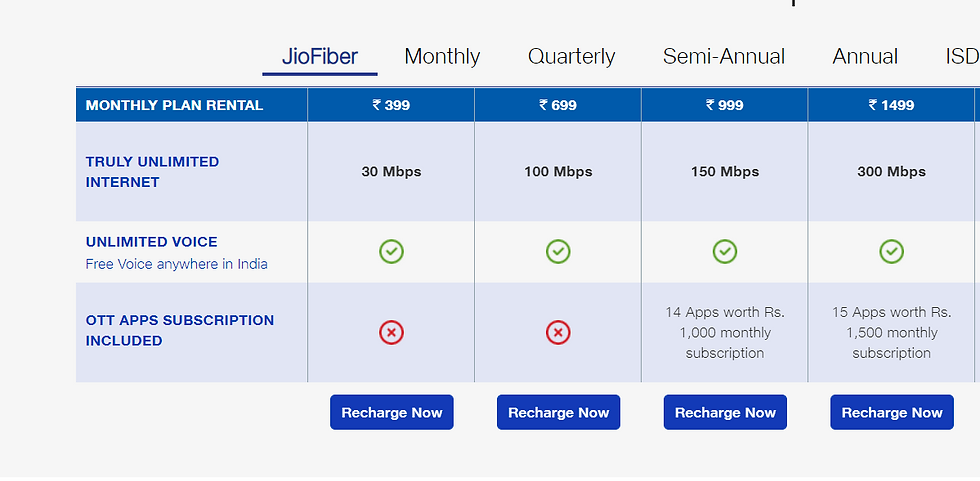
Which is the plan you find most attractive from all of them?
When we look closely, the two plans of 399 and 699 are merely a decoy, which I have explained later. To keep it simple, they are just merely a distraction for the subscribers, and hardly anyone would be purchasing these plans. We all live in an era where OTT Apps are the most viewed (Disney, Netflix, Amazon, Voot, etc). Most of us would go with the 999 plan, as it has all the things one needs. The first one has a poor speed and no one would be buying it in the first place. The decision to be made would be between the second plan and the third, and since the second one doesn't have any OTTsubscription, the users are most likely to go with the third plan(999). As quoted by Dan Ariely - Humans rarely choose things in absolute terms. We don't have an internal value meter that tells us how much things are worth. Rather, we focus on the relative advantage of one thing over another and estimate value accordingly. Here we can clearly see that plan 999 is a no-brainer, and most would be going for this one only(myself included). Had they not included any of the other plans, it would be very difficult to attract buyers as buyers won't have anything to compare with. We, humans, have a tendency to think in relative terms and this is what marketing teams hired by big firms capitalize on. They will provide us with relative things to compare, and often put a decoy in between, which no one is likely to purchase. Their main target(here 999 plan) is often the one that looks good to you when you compare it with other things of the same nature. We are always looking at things around us in relation to others, and try to find the best deal in which we are sure that our loss is minimized.
For eg, when I got to know that Jio had launched the fiber plan, although I was sure that I would choose it, I reluctantly compared it with the Airtel Fibre plan just to check. Who knows if Airtel were providing better services!!? I compared the prices and to my surprise, I found out that prices were exactly the same. The comparisons which my mind made stood out on the basis of comparison of 1 thing with another, and who was providing better services at the same prices.
This is Relativity at its best, which we humans do on daily basis, from comparing our grades, salary, profession, and many more things. We always compare jobs with jobs, vacations with vacations, clothes, cars, etc. Remember the last time you went shopping and compared thousands of clothes before finally choosing one. This natural behavior of ours is what the industries tend to capitalize on. They always provide you with the options to choose from, as humans tend to make a decision fast based on the comparison provided.
The cost of zero
Have you ever wondered what happens when something is offered to you for free(zero cost)?? We immediately have a tilt in our emotional balance towards that thing, even if we wouldn't have purchased it otherwise. The gravitational pull of free is so strong that if you want to attract a crowd, provide something for free, and you would see people rushing in to find out what's on sale. A great example of one such company is DCATHALON, which has expanded rapidly across India, growing at an exponential speed. What did they do?? They provided free services, such as ground for playing cricket, football, table tennis, badminton, cycling, etc, and all types of sports equipment are provided by the company itself. You just have to go and play!! For FREE!! In a market that was dominated by Nike, Addidas, and Puma, Dcathalon has outgrown them in their own playground.
You can click here to read the article from the Economic Times if anyone is interested in reading.


The results show something that is loud and clear - The price of zero plays a unique role in our decision making. This strategy, when used effectively can bring fortunes to a company.
Recently, Amdocs(telecom company) decided to pay up for the employee's infrastructure upgrade, all of which would be free(The company would pay the rent, but later when offices open up, the infrastructure has to be given back again). The infrastructure included buying headphones worth 10,000 rs, keyboards, printers, monitors, etc. Now, ideally, until this was announced, no employee had any need of these things, particularly to buy at such a heavy price. But as soon as it was announced that it all would be free, employees began to buy things in large no(the limit was a max of 20000 rs), things that they won't be using and wouldn't have bought otherwise.
What is it about Free that is so enticing? Why do we have an irrational urge to jump for a Free item, even when it's not what we really want?
It's because we humans are afraid of loss. If you were going to buy 10000 rs headphones, you would have pondered over it 10 times to buy or not. But since FREE has no emotional value attached, there is no possibility of a loss! What would happen if we buy something costly and it gets damaged? We regret making a poor decision, and also worry about the money lost. With free, there is no downside. We won't care if the product gets damaged or spoiled, as it was for free.
Now since you understand the value of free, let's take a look at how marketing teams of big firms exploit this human behavior in their best interest.
Let's again consider the marketing done by Jio. Lets us forget the OTT services provided in the pack by both telecom giants for a moment. Let's consider from a price point of view only. The decision to choose between Airtel and Jio would have been difficult, as both are offering the same services at the same prices. Now, since consumers would always make relative decisions, and the marketing team of Jio would have known this, they provided a no brainer deal to customers. 1 month of FREE internet service!! Although this would cause them a loss initially, it would later bring in the customers and over a long period of time would result in huge profits. Consider the below options.
Jio Fibre - Upto 150 Mbps - 999 Rs
Airtel Fibre - Upto 150 Mbps - 999 Rs
Jio Fibre - Upto 150 Mbps - 999 Rs + 1 Month free internet trial
What would you choose???
99% of people would go with the 3rd one, as it has the FREE version. FREE directly communicates to humans - A Zero Possibility of Loss and Humans by nature would want to go with things where they feel they would have a minimum loss involved.
Jio made sure that they provide more services(OTT subscriptions) at the same price, but the masterstroke by their marketing team was providing the services free for 1 month. The team knows the cost of free, and they made the best use of it to attract consumers. The free service would also allure those customers that would have no need of a Fibre connection at home, but since it's being provided free for 1 month, what's the problem in using it? No downside!!
Airtel team, if you are reading this article, you really need a good marketing team and capitalize the power of free, if you wish to grow your customer base and if you want to survive in for a long game, otherwise, Jio would be the only monopoly left!!

The Decoy :
Relativity is easy to understand. But there is one aspect of relativity that consistently trips us up. It is this:
We not only tend to compare things with one another but also tend to focus on comparing things that are easily comparable - and avoid comparing things that cannot be compared easily.
I was recently looking for a camera set up to buy, and I landed on one site (thanks to google SEO). There was one offer going on, which was as follows -
1. Canon M50 (Rs 48000)
2. Canon M200 (Rs 50000)
3. Canon M50 with 2 Year Free warranty
This is a classical approach used by marketing firms, where if they wish to sell a particular product more, they provide something for free along with the product. Here you can see that there were two cameras offered at the same price, but one came with a free micro SD card. The Gravitational pull of free is so strong that people who would have not been interested in buying would also consider purchasing, as they would find the deal to be really attractive. Well, let's now look at the seller's POV. What do you think he was interested in selling? M50 would be the obvious one. The Canon M200 is just a decoy sitting in there, so you compare it with that but would go obviously for the better deal(even if it might not be). Since we like to make decisions based on RELATIVE aspects, and we don't know much about both the devices, so canon M50 with a free warranty appears the good option. The canon M200 act as a decoy here, which no one would be interested in buying at the same price. The marketers know that canon M50 with a free 1 year warranty would overweigh perception for the normal Canon M50, and no one would be buying the M200. Hence it is put as a decoy there. Decoy is the secret agent used by marketing teams across the world that generate huge revenue for the firms as it capitalizes over the human decisions that we inherently are bound to make.
Another classic example to consider is that if you are single and want to attract attractive dating partners at a marriage event. The best suggestion is to take a friend that is less attractive than you. The friend would act as a decoy, and it might help you get the date(Ofcourse speaking and other things matter as well). Don't tell this to your friend of course!!
The Downside of Relativity.
Since we humans are constantly comparing ourselves to one another, it can breed jealousy and envy in our lives. Consider if your friends get a salary hike and you don't, and you both worked for the same position equally hard, you would envy him no matter what because you think you also deserved the raise. Your friend bought a new bike, you would compare it with yours and feel miserable. This is the problem with relativity - we look at our decisions in a relative way and compare them locally to
the available alternative.
The only way to deal with this is to move towards smaller circles that boost our relative happiness. For eg- If you are focusing on buying a new car, do not compare it with higher models, compare it with the cars of your budget and of the lower one that you can afford.
The only way to deal with this is to make your circle of comparison smaller, not larger. The more we have, the more we want. And the only cure is to break the cycle of relativity.
I hope you found this article interesting, kindly leaves a thumbs up or comment. This has been inspired by the book 'Predictably Irrational'. It's a great read, and you can buy it by clicking here.


Comments